
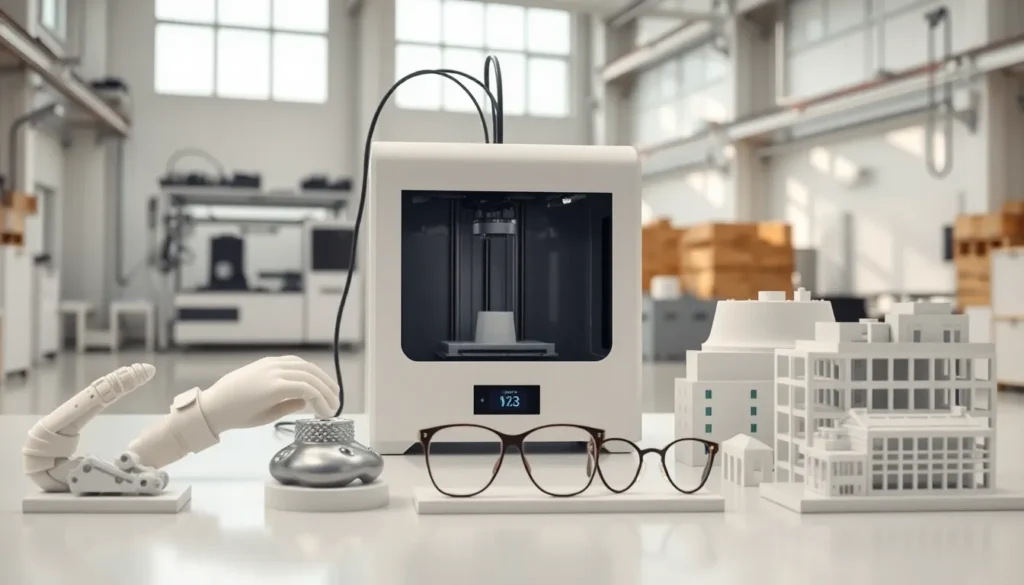

3D printing examples show how this technology reshapes manufacturing, healthcare, and daily life. From custom prosthetics to rocket parts, additive manufacturing has moved far beyond prototyping into full-scale production. Industries now rely on 3D printing to cut costs, speed up development, and create products that traditional methods cannot produce.
This article explores practical 3D printing examples across six major sectors. Each example demonstrates how businesses and institutions use this technology to solve real problems. Whether producing patient-specific implants or building affordable housing, 3D printing delivers results that matter.
Table of Contents
ToggleKey Takeaways
- 3D printing examples span healthcare, aerospace, automotive, consumer products, construction, and education—proving the technology’s broad real-world impact.
- Custom prosthetics that once cost $40,000 can now be 3D printed for under $500, making life-changing devices accessible to more patients.
- Aerospace giants like GE Aviation and SpaceX use 3D printing to create lighter, more durable components that traditional manufacturing cannot produce.
- Construction companies now 3D print entire homes in under 48 hours, offering a faster and more affordable solution to housing shortages.
- Businesses reduce inventory costs and development time by printing spare parts on demand and rapidly prototyping new product designs.
- Schools and universities use 3D printing examples to teach hands-on STEM skills and accelerate research across multiple disciplines.
Healthcare and Medical Applications
Healthcare offers some of the most impactful 3D printing examples in use today. Doctors and researchers use additive manufacturing to create devices that fit individual patients perfectly.
Custom Prosthetics and Orthotics
Traditional prosthetic limbs can cost thousands of dollars and take weeks to produce. 3D printing changes this equation. Companies like Open Bionics now create functional prosthetic hands for a fraction of the cost. A child’s prosthetic arm that once cost $40,000 can now be printed for under $500. These devices are lighter, more comfortable, and easier to replace as children grow.
Surgical Planning Models
Surgeons use 3D-printed anatomical models to prepare for complex procedures. Before operating on a patient with a brain tumor, a neurosurgeon can hold an exact replica of that patient’s skull and tumor. This preparation reduces surgery time and improves outcomes. Hospitals report up to 25% shorter operating times when surgeons practice on printed models first.
Bioprinting and Implants
3D printing examples in bioprinting push the boundaries of what medicine can achieve. Researchers have successfully printed living tissue, including skin grafts for burn victims. Companies produce patient-matched titanium implants for hip and knee replacements. These implants integrate better with bone tissue and last longer than standard options.
Dental applications represent another major category. Dentists print custom aligners, crowns, and surgical guides daily. This speeds treatment and improves accuracy compared to traditional molds.
Aerospace and Automotive Manufacturing
Aerospace companies were early adopters of 3D printing, and they continue to push the technology forward. The automotive industry followed closely behind.
Lighter Aircraft Components
Weight matters in aviation. Every pound saved on an aircraft reduces fuel consumption over its lifetime. GE Aviation 3D prints fuel nozzles for jet engines that are 25% lighter and five times more durable than conventionally manufactured parts. A single Boeing 787 Dreamliner contains over 30 3D-printed components.
SpaceX provides striking 3D printing examples in rocket manufacturing. The company prints engine parts that would be impossible to create through traditional machining. Their SuperDraco engines feature regeneratively cooled combustion chambers produced entirely through additive manufacturing.
Rapid Prototyping in Automotive
Car manufacturers use 3D printing to test designs quickly. Ford prints multiple prototype parts in a single day, a process that once took months. Engineers can hold physical parts, test fits, and identify problems before committing to expensive tooling.
Bugatti demonstrates high-performance 3D printing examples with its brake calipers. Made from titanium, these components weigh 40% less than aluminum alternatives while handling extreme heat and stress. Each caliper takes 45 hours to print but delivers performance no other manufacturing method can match.
Spare Parts on Demand
Both industries benefit from on-demand spare parts production. Instead of warehousing thousands of components, companies can print replacements when needed. This approach reduces inventory costs and ensures older vehicles and aircraft can stay operational longer.
Consumer Products and Everyday Items
3D printing examples extend well beyond industrial applications. Consumers now interact with printed products regularly, often without knowing it.
Custom Footwear
Adidas sells running shoes with 3D-printed midsoles. Their 4DFWD technology uses lattice structures optimized for forward motion. Each midsole contains thousands of struts designed through computational modeling. New Balance and Under Armour offer similar products, and custom orthotics represent a growing market.
Eyewear and Accessories
Several eyewear brands now 3D print frames directly. MYKITA produces glasses that are lighter and stronger than injection-molded alternatives. Customers can choose from designs that traditional manufacturing cannot produce economically.
Jewelry designers embrace 3D printing for intricate pieces. Complex geometric patterns and customized engravings become simple to produce. Small designers compete with established brands by offering unique products without heavy upfront investment.
Home Goods and Art
3D printing examples appear throughout modern homes. Designers sell printed vases, lamp shades, and decorative objects online. The technology enables small-batch production that would be cost-prohibitive through traditional manufacturing.
Artists use 3D printing to realize sculptures and installations that exist first as digital designs. Museums commission printed replicas of fragile artifacts so visitors can touch and examine them safely.
Architecture and Construction
Construction represents one of the fastest-growing areas for 3D printing applications. Companies now print entire buildings using concrete and other materials.
Printed Houses
ICON, a Texas-based company, prints homes in under 48 hours of active print time. Their Vulcan printer extrudes a concrete mixture layer by layer, creating walls for single-story structures. In 2023, ICON completed a community of 3D-printed homes in Austin. Each house costs significantly less than traditional construction.
Similar projects appear worldwide. Dubai mandates that 25% of new buildings must include 3D-printed components by 2030. China has printed multi-story apartment buildings. These 3D printing examples demonstrate how the technology addresses housing shortages.
Architectural Models and Components
Architects print detailed scale models of proposed buildings. Clients can see and touch their future projects before construction begins. This visualization helps identify design issues early and improves communication between architects and clients.
Construction firms print complex concrete formwork, decorative facades, and structural components. Custom shapes that require expensive molds in traditional construction become economical through printing. Curved walls and organic forms no longer carry premium costs.
Sustainable Building
Some companies experiment with printed structures using recycled materials. Others explore printing with local soil or sustainable concrete alternatives. These approaches could reduce construction’s carbon footprint significantly.
Education and Prototyping
Schools and universities use 3D printing to enhance learning and accelerate research. The technology gives students hands-on experience with manufacturing concepts.
STEM Education
Students learn design principles by creating physical objects from their digital models. They see immediate results from their work, which increases engagement. Engineering programs use 3D printing to teach manufacturing processes, material science, and product development.
Middle and high schools incorporate printers into maker spaces. Students print components for robotics competitions, science fair projects, and art classes. These 3D printing examples prepare young people for careers in advanced manufacturing.
Research and Development
University labs rely on 3D printing for research equipment. Scientists print custom lab apparatus, reaction vessels, and testing fixtures. A researcher needing a specific tool can design and print it overnight rather than waiting weeks for a machinist.
Medical schools print anatomical models for student training. Future surgeons practice techniques on accurate replicas before working with real patients. Veterinary programs print models of animal anatomy for the same purpose.
Rapid Product Prototyping
Startups and established companies use 3D printing to test ideas quickly. A product designer can print a new concept, evaluate it, make changes, and print again, all within a single day. This speed reduces development time from months to weeks.
3D printing examples in prototyping span every industry. Electronics companies test enclosure designs. Toy manufacturers evaluate new products. Kitchen gadget inventors refine their concepts through dozens of printed iterations.


