
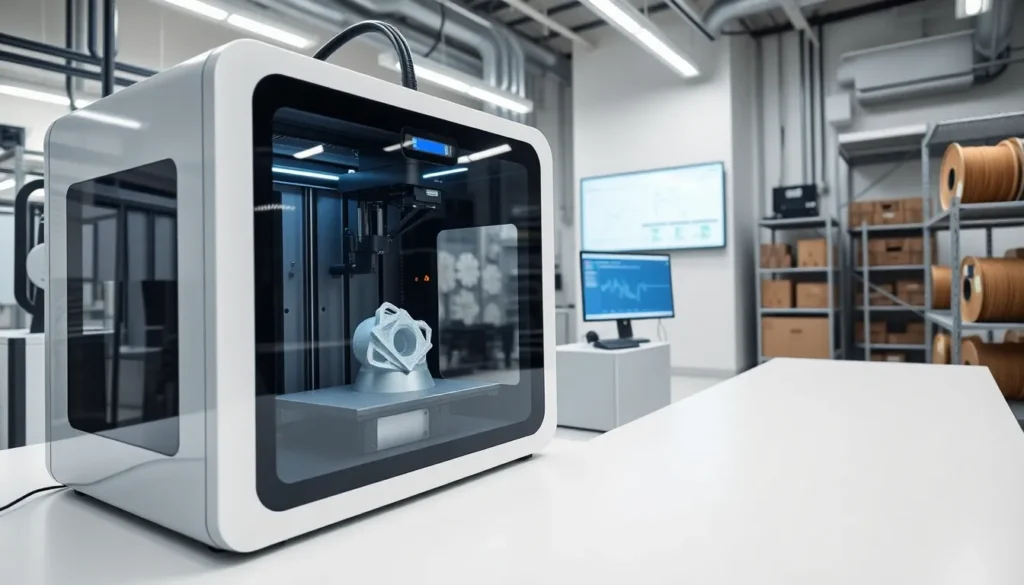

3D printing trends in 2026 will reshape how industries design, produce, and deliver products. The technology has moved far beyond prototyping. It now drives full-scale production across aerospace, healthcare, consumer goods, and construction.
This year marks a turning point. Printers handle multiple materials in single builds. AI software generates optimized designs in minutes. Sustainable filaments replace petroleum-based plastics. Hospitals print patient-specific implants on site.
These shifts create real opportunities for manufacturers, designers, and entrepreneurs. The following sections break down the key 3D printing trends that will define 2026 and explain what each means for businesses ready to adapt.
Table of Contents
ToggleKey Takeaways
- 3D printing trends in 2026 focus on multi-material capabilities, AI-driven workflows, sustainability, healthcare expansion, and on-demand manufacturing.
- Multi-material printers now combine rigid plastics, flexible polymers, and conductive materials in single builds, reducing production time by up to 40%.
- AI-powered generative design tools create optimized parts in hours instead of weeks, lowering the expertise barrier for small businesses.
- Sustainable materials like recycled PETG, algae-based filaments, and closed-loop recycling systems are becoming competitive advantages for manufacturers.
- Healthcare leads growth with on-site surgical guides, patient-specific implants, and bioprinted tissue scaffolds entering clinical trials.
- Distributed manufacturing and digital inventories allow companies to print spare parts on demand, cutting storage costs and eliminating supply chain delays.
Advances in Multi-Material and Full-Color Printing
Multi-material 3D printing has reached commercial maturity. Machines now combine rigid plastics, flexible polymers, and conductive materials within a single print job. This capability eliminates assembly steps and reduces production time by up to 40%.
Full-color printing has also improved dramatically. Voxel-level color control allows designers to produce parts with photorealistic surface finishes. Consumer product companies use this feature for packaging prototypes and finished goods alike.
Stratasys and HP lead the industrial segment with machines that handle five or more materials simultaneously. Desktop manufacturers like Bambu Lab and Prusa have introduced affordable multi-material systems for smaller operations.
The practical benefits extend across sectors. Automotive suppliers print dashboards with soft-touch surfaces and hard structural elements in one pass. Toy manufacturers create finished products without painting or post-processing.
3D printing trends in 2026 show that multi-material capability is no longer a luxury. It has become a baseline expectation for serious production environments.
AI-Driven Design and Automated Workflows
Artificial intelligence now handles tasks that once required skilled engineers. Generative design software produces optimized geometries based on load requirements, material properties, and manufacturing constraints. What took weeks now takes hours.
Automated workflows connect design, slicing, and machine operation into seamless pipelines. Print farms run 24/7 with minimal human intervention. Software monitors build quality in real time and pauses jobs when defects appear.
Autodesk Fusion and nTopology offer AI-assisted design tools that integrate directly with 3D printing workflows. These platforms suggest design improvements and flag potential print failures before production begins.
Machine learning also improves print parameters. Systems learn from previous builds and adjust settings automatically for different materials and geometries. This reduces failed prints and waste.
Small businesses benefit as much as large manufacturers. Cloud-based AI tools lower the expertise barrier. A furniture startup can produce topology-optimized brackets without hiring structural engineers.
3D printing trends point toward increasing automation. Companies that adopt AI-driven workflows gain speed and cost advantages that manual processes cannot match.
Sustainable Materials and Eco-Friendly Practices
Environmental concerns have pushed 3D printing toward greener practices. Recycled and bio-based materials now account for a growing share of filament and powder sales.
PLA derived from corn starch remains popular, but newer options offer better performance. Algae-based filaments, recycled PETG, and wood-fiber composites provide sustainable alternatives without sacrificing print quality.
Closed-loop recycling systems have emerged as a key 3D printing trend. Companies like Filamentive and Re:3D sell machines that grind failed prints into reusable pellets. This approach cuts material costs and reduces landfill waste.
Energy consumption has also improved. Newer printer designs use more efficient heating systems and sleep modes. Some manufacturers now publish carbon footprint data for their machines.
Large corporations set sustainability targets that drive adoption. When a major retailer requires suppliers to document environmental impact, 3D printing with recycled materials becomes a competitive advantage.
3D printing trends in 2026 reflect broader market pressure for sustainable manufacturing. Companies that ignore this shift risk losing contracts and customer trust.
Expansion in Healthcare and Bioprinting
Healthcare applications represent one of the fastest-growing 3D printing trends. Hospitals now produce surgical guides, dental aligners, and prosthetic limbs on site. This cuts delivery times from weeks to days.
Bioprinting has advanced from research labs to clinical trials. Companies like Organovo and CELLINK print living tissue scaffolds for skin grafts and cartilage repair. FDA approval pathways for bioprinted products have become clearer.
Patient-specific implants show particular promise. Surgeons use CT scans to create exact-fit titanium hip replacements and cranial plates. These custom devices integrate better with bone tissue and reduce recovery times.
Dental practices have widely adopted 3D printing. A single office can produce crowns, bridges, and surgical guides without sending work to outside labs. The economics favor in-house production at scale.
Pharmaceutical printing also advances. Researchers develop pills with customized release profiles, combining multiple drugs in single doses. This technology could transform medication management for patients with complex conditions.
3D printing trends suggest healthcare will remain a primary growth sector through 2026 and beyond.
On-Demand Manufacturing and Supply Chain Integration
Supply chain disruptions have accelerated interest in distributed manufacturing. 3D printing enables production close to the point of use, reducing shipping costs and delivery times.
Digital inventories replace physical warehouses for many spare parts. Instead of storing thousands of components, companies keep 3D files and print replacements when needed. This approach cuts storage costs and eliminates obsolete inventory.
Major logistics companies have invested in 3D printing infrastructure. UPS and DHL operate printing facilities near distribution hubs. They produce parts and ship same-day within local regions.
Automotive and aerospace industries lead adoption. A dealership can print a discontinued bracket rather than source it from overseas. An airline can produce certified replacement parts at maintenance facilities.
Smaller manufacturers also benefit from this 3D printing trend. Contract printing services offer production capacity without capital investment. A startup can scale from prototypes to thousands of units using the same service provider.
3D printing trends in 2026 show strong momentum toward decentralized production. Companies that integrate additive manufacturing into their supply chains gain flexibility that traditional methods cannot provide.


