
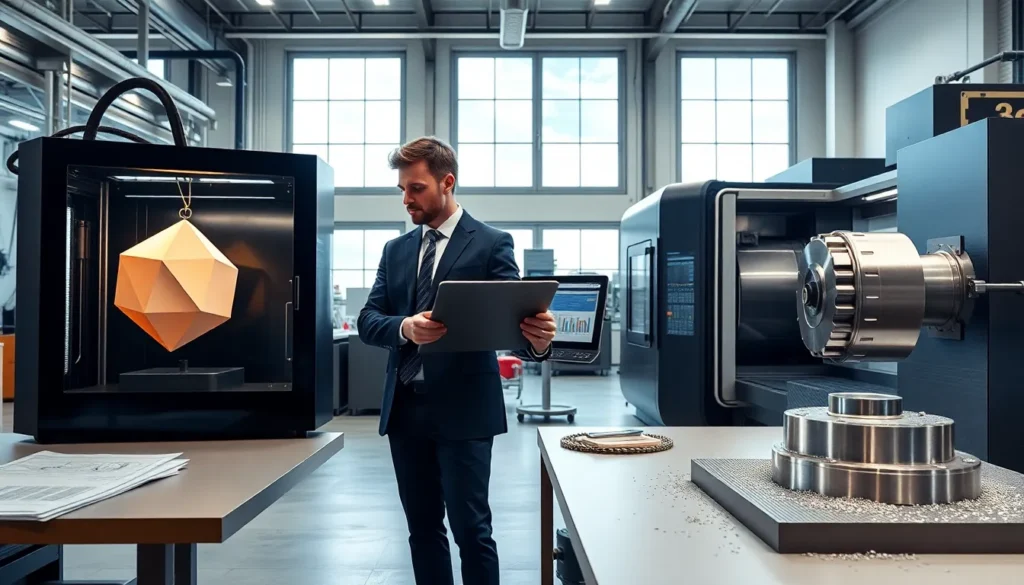

3D printing vs traditional manufacturing represents one of the most significant decisions businesses face today. Both methods produce physical objects, but they differ in approach, cost structure, and ideal use cases. 3D printing builds objects layer by layer from digital files. Traditional manufacturing uses subtractive or formative processes like machining, molding, or casting. Understanding these differences helps companies choose the right method for their specific needs. This guide breaks down the key distinctions between 3D printing and traditional manufacturing across process, cost, materials, and practical applications.
Table of Contents
ToggleKey Takeaways
- 3D printing vs traditional manufacturing comes down to volume—3D printing excels at prototypes and small batches, while traditional methods dominate high-volume production.
- 3D printing requires no tooling and offers low startup costs, making it ideal for custom parts and rapid iteration.
- Traditional manufacturing delivers lower per-unit costs at scale, with injection molding becoming cheaper than 3D printing between 100–1,000 units for simple parts.
- 3D printing enables complex geometries like internal channels and lattice structures that are impossible or costly with traditional techniques.
- Surface finish and mechanical consistency favor traditional manufacturing, though industrial 3D printing quality continues to narrow the gap.
- Many companies strategically combine both methods—prototyping with 3D printing before transitioning to injection molding for mass production.
How 3D Printing Works Compared to Traditional Methods
3D printing, also called additive manufacturing, creates objects by depositing material layer by layer. A digital 3D model guides the printer, which adds material until the object takes shape. Common 3D printing technologies include Fused Deposition Modeling (FDM), Stereolithography (SLA), and Selective Laser Sintering (SLS).
Traditional manufacturing takes a different approach. Subtractive methods like CNC machining start with a solid block and remove material to create the final shape. Formative methods like injection molding force material into pre-made molds. Casting pours liquid material into molds where it solidifies.
The fundamental difference comes down to addition versus subtraction or formation. 3D printing adds only what’s needed. Traditional methods often require more raw material and specialized tooling.
Setup requirements also differ significantly. 3D printing needs a digital file and the printer itself. Traditional manufacturing often requires custom molds, dies, or tooling that can take weeks to produce. This makes 3D printing faster for prototypes and small batches, while traditional methods excel at high-volume production.
Design freedom represents another major distinction. 3D printing can produce complex geometries, internal channels, and lattice structures that would be impossible or extremely expensive with traditional techniques. Traditional manufacturing imposes more constraints but delivers consistency at scale.
Cost and Time Considerations
Cost structures between 3D printing and traditional manufacturing differ dramatically based on volume.
3D printing carries low startup costs. No molds or tooling are required. The per-unit cost stays relatively flat whether producing one item or fifty. This makes 3D printing economical for prototypes, custom parts, and small production runs.
Traditional manufacturing requires significant upfront investment. Injection molds can cost anywhere from $3,000 to $100,000+ depending on complexity. But, once tooling exists, per-unit costs drop sharply. At volumes of thousands or millions, traditional manufacturing becomes far more cost-effective.
The break-even point varies by product and method. For simple plastic parts, injection molding typically becomes cheaper than 3D printing somewhere between 100 and 1,000 units. Complex metal parts may have different crossover points.
Time considerations follow a similar pattern. 3D printing delivers faster turnaround for initial production. A prototype can go from design file to physical object in hours or days. Traditional manufacturing requires tooling production, which adds weeks or months to the timeline.
But, production speed differs at volume. An injection molding machine can produce thousands of identical parts per day. Most 3D printers produce parts one at a time, limiting throughput. For high-volume orders, traditional manufacturing wins on delivery speed.
The comparison between 3D printing vs traditional methods eventually depends on quantity, timeline, and budget constraints.
Material Options and Quality Differences
Material selection affects performance, appearance, and cost. Both 3D printing and traditional manufacturing offer extensive options, though they differ in availability and characteristics.
3D printing materials include:
- Plastics: PLA, ABS, PETG, Nylon, and specialty polymers
- Resins: Standard, flexible, castable, and engineering-grade options
- Metals: Stainless steel, titanium, aluminum, and precious metals
- Composites: Carbon fiber-reinforced and glass-filled materials
Traditional manufacturing materials span nearly every substance that can be machined, molded, cast, or formed. This includes the full range of metals, plastics, ceramics, glass, and composites.
Quality differences exist between the two approaches. 3D printed parts may show layer lines, requiring post-processing for smooth finishes. Surface quality depends on layer height, print orientation, and technology used. SLA produces smoother surfaces than FDM, for example.
Traditional manufacturing typically delivers superior surface finish straight from production. Injection-molded parts emerge smooth and consistent. CNC-machined components meet tight tolerances without additional finishing.
Mechanical properties also vary. 3D printed parts can exhibit anisotropic behavior, they’re stronger in some directions than others due to layer orientation. Injection-molded and machined parts generally show more uniform strength throughout.
That said, 3D printing technology continues to advance. Industrial metal 3D printing now produces parts that meet aerospace specifications. The gap between 3D printing and traditional manufacturing quality narrows each year.
When to Choose 3D Printing Over Traditional Manufacturing
Selecting between 3D printing vs traditional manufacturing depends on specific project requirements. Each method suits different scenarios.
Choose 3D printing when:
- Prototyping: Testing designs before committing to expensive tooling makes sense. 3D printing allows rapid iteration at low cost.
- Low volumes: Production runs under 100-500 units often favor 3D printing due to eliminated tooling costs.
- Complex geometry: Parts with internal channels, lattice structures, or organic shapes print easily but machine poorly.
- Customization: Each printed item can differ without additional cost. This benefits medical devices, dental appliances, and personalized products.
- Speed to market: When time matters more than per-unit cost, 3D printing delivers faster initial production.
Choose traditional manufacturing when:
- High volumes: Production runs of thousands or millions achieve significant cost savings through traditional methods.
- Material requirements: Certain materials or material certifications may only be available through traditional processes.
- Surface finish: Applications requiring smooth surfaces or specific textures benefit from molding or machining.
- Mechanical demands: Load-bearing or high-stress applications may require the consistent properties of traditional manufacturing.
Many companies use both methods strategically. They prototype with 3D printing, then transition to injection molding for mass production. Or they 3D print complex components while traditionally manufacturing simpler parts.
The 3D printing vs traditional manufacturing decision isn’t always either-or. Smart manufacturers evaluate each part individually and choose the best method for that specific application.


