
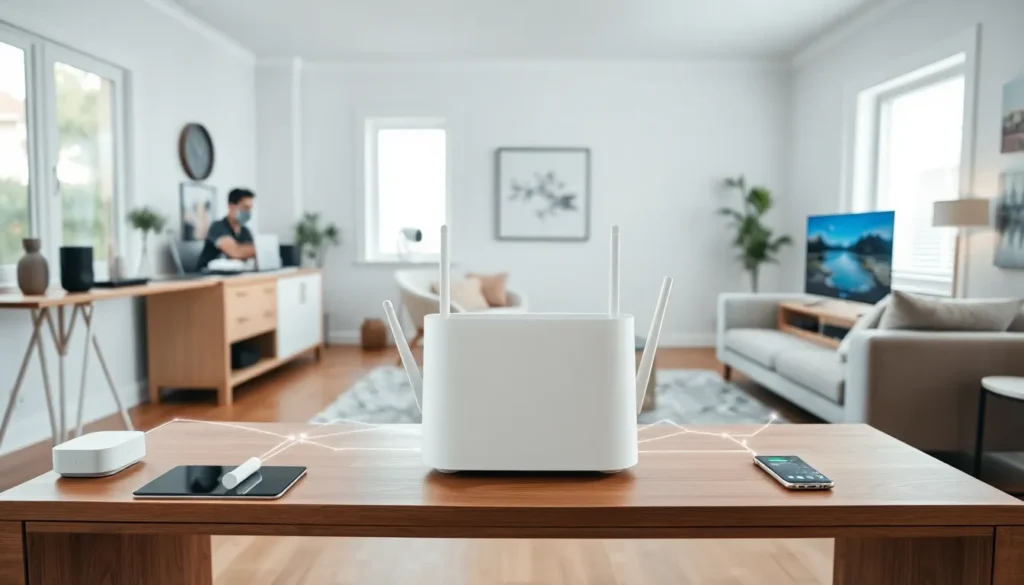

Home networking trends 2026 will reshape how households connect, stream, and secure their digital lives. The past few years brought incremental upgrades, but the coming year promises something bigger. Faster wireless standards, smarter network management, and tighter security protocols are all converging at once.
Consumers now expect seamless connectivity across dozens of devices. Work-from-home setups remain common. Smart home gadgets continue multiplying. These demands push manufacturers and internet providers to deliver solutions that actually keep up. This article breaks down the key home networking trends 2026 will bring, from Wi-Fi 7 going mainstream to AI-driven optimization and beyond.
Table of Contents
ToggleKey Takeaways
- Wi-Fi 7 will go mainstream in 2026, delivering speeds up to 46 Gbps and Multi-Link Operation for better reliability in busy households.
- AI-powered network management will become standard, automatically optimizing connections, prioritizing devices, and detecting security threats without manual configuration.
- Matter, the universal smart home standard, will simplify device setup by allowing products from different brands to communicate seamlessly.
- Enhanced security features like WPA3 encryption, automatic firmware updates, and built-in VPN support are becoming standard in consumer routers.
- Mesh networking systems with Wi-Fi 7 support will become the default choice for homes over 1,500 square feet, with three-pack systems now more affordable than ever.
- Home networking trends 2026 show a shift toward self-managing networks that deliver faster speeds, smarter optimization, and stronger security with less user effort.
Wi-Fi 7 Adoption Goes Mainstream
Wi-Fi 7 (802.11be) will move from early adopter territory into everyday homes throughout 2026. Major router manufacturers already ship Wi-Fi 7 models, and device makers are embedding compatible chips into laptops, phones, and tablets.
The speed improvements are substantial. Wi-Fi 7 supports theoretical speeds up to 46 Gbps, roughly four times faster than Wi-Fi 6E. More importantly, it introduces Multi-Link Operation (MLO), which lets devices connect across multiple frequency bands simultaneously. This reduces latency and improves reliability, especially in busy households.
For home networking trends 2026, this matters because typical homes now run 15 to 25 connected devices. Video calls, 4K streaming, cloud gaming, and smart home sensors all compete for bandwidth. Wi-Fi 7 handles this congestion more efficiently than previous generations.
Prices will drop as competition heats up. Entry-level Wi-Fi 7 routers already approach the $200 mark, and mid-range options with mesh capabilities will become affordable for average consumers. Internet service providers will bundle Wi-Fi 7 hardware with their plans, accelerating adoption further.
One practical consideration: users need Wi-Fi 7-compatible devices to experience the full benefits. Expect smartphone and laptop makers to push this compatibility as a selling point throughout the year.
AI-Powered Network Management
AI-powered network management represents one of the most practical home networking trends 2026 will bring. Router manufacturers are embedding machine learning directly into their firmware, and the results are genuinely useful.
These systems learn household patterns. They recognize when someone starts a video call and automatically prioritize that device. They detect when gaming consoles need low-latency connections. They identify unusual traffic that might indicate a security threat.
Self-healing networks are becoming standard. When interference appears on one channel, AI-driven routers switch automatically, often before users notice any slowdown. Some systems now predict congestion before it happens based on time-of-day patterns.
The user experience improves dramatically. Instead of manually configuring QoS settings or rebooting routers, households get networks that optimize themselves. Parents can set device schedules through simple voice commands. Guest networks spin up with temporary passwords that expire automatically.
Several manufacturers lead this space. TP-Link’s HomeShield, Netgear’s Armor, and Eero’s TrueMesh all incorporate AI elements. In 2026, expect these features to appear in budget routers, not just premium models.
Privacy-conscious users should note that some AI features require cloud processing. Look for routers that offer local processing options if data privacy concerns matter to your household.
The Rise of Matter and Smart Home Integration
Matter, the universal smart home standard, will gain serious momentum as a defining home networking trend 2026. After a slow initial rollout, the ecosystem now includes hundreds of certified products from Apple, Google, Amazon, Samsung, and smaller manufacturers.
Matter solves a real problem. Previously, smart home devices often worked only within specific ecosystems. A Philips Hue bulb needed the Hue bridge. A Ring doorbell required Amazon’s app. Matter creates a common language that lets devices from different brands communicate directly.
For home networks, this means simpler setups and fewer headaches. Matter devices use Thread, a low-power mesh protocol, alongside Wi-Fi. Thread devices create their own mesh network for sensors and small gadgets, reducing congestion on the main Wi-Fi network.
The practical benefits are clear. Homeowners can mix and match devices based on features and price rather than ecosystem loyalty. A single app can control lights from one company, thermostats from another, and locks from a third.
Home networking trends 2026 will see router manufacturers building Thread border routers directly into their hardware. This eliminates the need for separate hubs. Apple’s HomePod, Amazon’s Echo, and Google’s Nest devices already serve as Thread border routers, and dedicated networking gear will follow.
Consumers should look for the Matter logo when shopping for smart home devices. It indicates compatibility with this growing standard.
Enhanced Security and Privacy Features
Security remains a top concern, and home networking trends 2026 reflect this priority. Manufacturers are building stronger protections directly into consumer routers rather than treating security as an afterthought.
WPA3 encryption is now standard on new routers. It provides stronger protection against password-guessing attacks and improves security on open networks. Most devices sold in 2026 will support WPA3, making network-wide encryption practical.
Automatic firmware updates have become the norm. Routers now patch vulnerabilities without user intervention. This addresses a major weakness, many home networks ran outdated firmware for years because users never logged into their router settings.
Device isolation features help protect networks from compromised smart home gadgets. Users can place IoT devices on separate network segments, preventing a hacked security camera from accessing a home computer. Some routers now suggest this configuration automatically.
DNS-level filtering blocks malicious websites before they load. Services like Cloudflare’s 1.1.1.1 for Families and NextDNS integrate directly into router settings. Parents use these same tools to filter inappropriate content for children.
VPN integration grows more common. Several routers now support built-in VPN clients, encrypting all household traffic without installing software on individual devices. This protects privacy and helps when accessing region-restricted content.
Home networking trends 2026 show manufacturers taking security seriously. The days of “set it and forget it” networking are ending, but the newer approach requires less user effort, not more.
Mesh Networks and Whole-Home Connectivity
Mesh networking systems continue expanding as a key home networking trend 2026. These multi-unit systems eliminate dead zones and provide consistent coverage throughout larger homes.
The technology has matured considerably. Early mesh systems sometimes struggled with backhaul, the connection between nodes. Newer systems use dedicated wireless or wired backhaul channels, maintaining speed even in multi-node configurations.
Wi-Fi 7 mesh systems represent the cutting edge. They combine the speed advantages of the new standard with the coverage benefits of mesh architecture. Brands like Netgear Orbi, Eero, and TP-Link Deco all offer Wi-Fi 7 mesh options.
Pricing has become more accessible. A quality three-pack mesh system now costs what a single high-end router cost five years ago. Entry-level mesh systems from Amazon and TP-Link start under $150.
Home networking trends 2026 show mesh systems becoming the default choice for homes over 1,500 square feet. Single routers still work for apartments and smaller spaces, but mesh provides better value for larger properties.
Installation has simplified dramatically. Most systems now use smartphone apps that guide users through placement and configuration. The apps test signal strength and suggest optimal node locations.
For renters or those in older homes with challenging layouts, mesh systems offer flexibility. Nodes can move as needs change, and additional units can extend coverage later. This adaptability makes mesh networking a practical long-term investment.


