
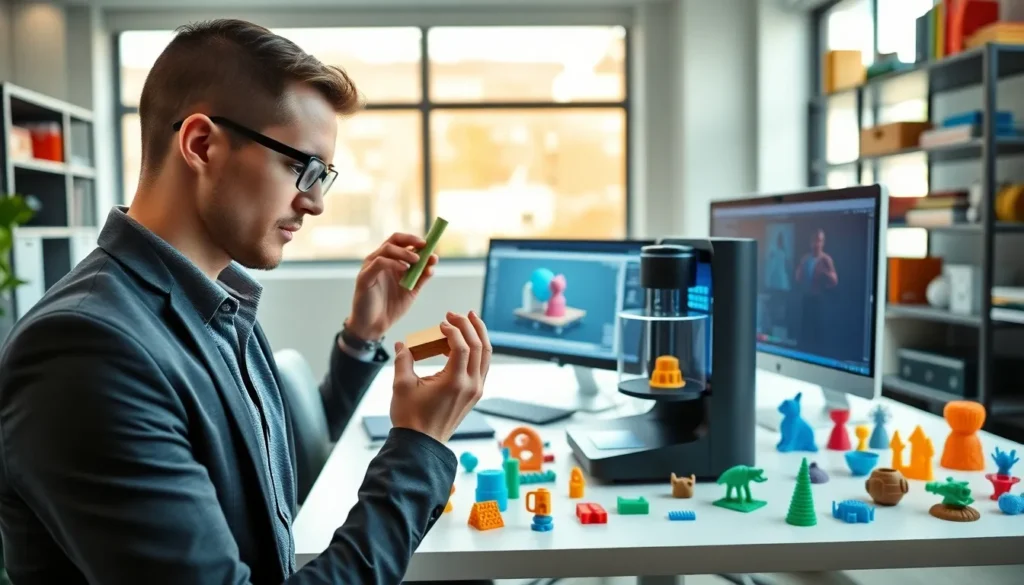

Top 3D printing has transformed how businesses and hobbyists create objects from digital designs. The industry continues to grow as new technologies make printing faster, more affordable, and more precise. In 2025, users have access to printers that produce everything from simple prototypes to functional end-use parts. This guide covers the leading technologies, selection criteria, applications, and trends shaping the future of top 3D printing.
Table of Contents
ToggleKey Takeaways
- Top 3D printing technologies like FDM, SLA, SLS, and MJF each serve distinct purposes—from affordable prototyping to high-precision industrial production.
- When choosing a 3D printer, evaluate print volume, resolution, material compatibility, speed, and software ecosystem based on your specific project needs.
- Medical, aerospace, automotive, and consumer product industries increasingly rely on 3D printing for customization, lightweight components, and faster development cycles.
- AI integration and faster print speeds are transforming the industry, reducing production times from 12 hours to just 2 hours in some cases.
- Sustainability efforts are growing with recyclable materials and energy-efficient machines making top 3D printing more environmentally friendly.
- Cloud-based printing services now allow users to access professional 3D printing capabilities without owning expensive equipment.
Leading 3D Printing Technologies Today
Several top 3D printing technologies dominate the market in 2025. Each method offers distinct advantages depending on the use case.
Fused Deposition Modeling (FDM) remains the most accessible option. FDM printers heat plastic filament and deposit it layer by layer. They work well for prototyping, educational projects, and home use. Entry-level FDM printers cost under $300, making them popular among beginners.
Stereolithography (SLA) uses UV light to cure liquid resin into solid objects. SLA produces parts with smooth surfaces and fine details. Jewelry designers, dentists, and engineers rely on SLA for high-precision work. Resin costs more than filament, but the quality justifies the expense for detailed applications.
Selective Laser Sintering (SLS) fuses powdered material using a laser. SLS creates strong, functional parts without support structures. Manufacturers use SLS for end-use components and small production runs. The technology handles nylon, glass-filled polymers, and other industrial materials.
Multi Jet Fusion (MJF) from HP delivers fast production speeds with consistent quality. MJF printers apply fusing agents to powder beds before exposing them to heat. This process creates durable parts suitable for functional testing and manufacturing.
Top 3D printing professionals often use multiple technologies based on project requirements. FDM handles rough prototypes quickly. SLA delivers presentation-quality models. SLS and MJF produce parts ready for real-world use.
Key Factors When Choosing a 3D Printer
Selecting the right printer requires careful evaluation of several factors. Budget, materials, and intended use all influence the decision.
Print Volume determines the maximum size of objects a printer can create. Desktop printers typically offer build volumes between 150mm and 300mm per axis. Industrial machines handle much larger parts. Buyers should assess their largest expected projects before purchasing.
Resolution and Accuracy matter for detailed work. Layer height affects surface finish, smaller layers produce smoother results but increase print time. Top 3D printing for jewelry or dental applications demands layer heights under 50 microns. General prototyping works fine at 100-200 microns.
Material Compatibility varies by technology. FDM printers support PLA, ABS, PETG, and specialty filaments. SLA machines use standard, tough, flexible, and castable resins. Industrial printers handle metals, carbon fiber composites, and high-performance polymers.
Speed and Throughput affect productivity. Some printers complete parts in hours: others take days. Businesses producing multiple parts daily need faster machines or multiple units.
Software Ecosystem impacts the user experience. Good slicing software simplifies file preparation and optimizes print settings. Some manufacturers lock users into proprietary software. Others support open-source alternatives.
Support and Community help users solve problems. Established brands offer customer service, documentation, and active user forums. A strong community shares settings, modifications, and troubleshooting tips.
Top 3D printing success depends on matching the printer to specific needs rather than chasing the most expensive option.
Popular Applications of 3D Printing
Top 3D printing serves diverse industries with applications growing each year.
Prototyping remains the most common use. Engineers and designers create physical models to test form, fit, and function. Iterating with printed prototypes costs less than traditional manufacturing methods. Companies save weeks of development time by printing multiple design versions.
Medical and Dental fields rely heavily on 3D printing. Surgeons plan complex procedures using patient-specific anatomical models. Dental labs produce crowns, bridges, and aligners with precise fits. Prosthetic limbs and hearing aids now routinely come from 3D printers.
Aerospace and Automotive industries print lightweight components. Boeing, Airbus, and SpaceX use additive manufacturing for brackets, ducts, and structural parts. Car manufacturers prototype new designs and produce custom tooling. Some racing teams print functional parts for competition vehicles.
Consumer Products benefit from mass customization. Eyewear companies offer custom-fit frames. Shoe brands print personalized midsoles. Jewelry designers create unique pieces without traditional mold costs.
Architecture and Construction professionals print building models and increasingly explore full-scale structures. Several companies now print concrete homes layer by layer. These projects demonstrate potential for affordable housing solutions.
Education uses top 3D printing to teach design thinking and manufacturing concepts. Students learn CAD software and bring their ideas to life. Schools from elementary through university level incorporate 3D printers into curricula.
The breadth of applications continues expanding as materials improve and costs decrease.
Emerging Trends Shaping the Industry
Several trends will define top 3D printing through 2025 and beyond.
Faster Print Speeds address a longtime limitation. New technologies like CLIP (Continuous Liquid Interface Production) and high-speed FDM dramatically reduce production times. What once took 12 hours now finishes in 2. Speed improvements make 3D printing viable for higher-volume production.
AI Integration streamlines the printing workflow. Machine learning algorithms optimize support structures, predict failures, and suggest ideal settings. Some systems automatically adjust parameters during printing to prevent defects.
Sustainability Focus grows as environmental concerns increase. Manufacturers develop recyclable and biodegradable materials. Some companies offer filament made from recycled plastics. Energy-efficient machines reduce the carbon footprint of printing operations.
Metal Printing Accessibility expands beyond industrial settings. Desktop metal printers now cost under $100,000, still expensive, but far below previous price points. Small businesses can produce metal parts without outsourcing. Bound metal deposition and DMLS technologies become more user-friendly.
Multi-Material Printing enables complex functional parts. Printers that combine rigid and flexible materials in single objects create new possibilities. Electronics embedded during printing eliminate assembly steps.
Cloud-Based Services simplify access to top 3D printing capabilities. Online platforms connect designers with print farms worldwide. Users upload files and receive finished parts without owning equipment.
Standardization Efforts improve quality consistency. Industry groups develop specifications for materials and processes. Better standards help manufacturers trust 3D printed parts for critical applications.
These trends point toward a future where top 3D printing handles more production work alongside traditional manufacturing.


